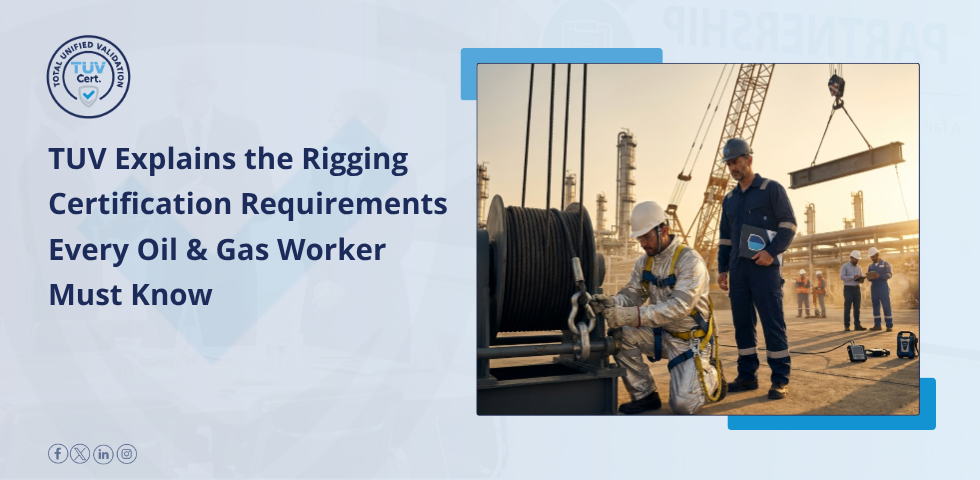
Don't Step Onto an Oil & Gas Site Without Understanding rigging certification Saudi Arabia First
Before Entering Any Oil & Gas Site, TUV Explains the Rigging Certifications You Cannot Ignore
Have you ever wondered why some workers are allowed onto major Oil & Gas sites immediately, while others face delays, rejected applications, or restricted access despite having years of field experience? The answer often comes down to one critical factor: certification.
In today's high-risk industrial environment, experience alone is no longer enough.
Before stepping onto many construction, petrochemical, refinery, or energy project sites, professionals are expected to demonstrate verified competence through recognized qualifications such as rigging certification Saudi Arabia.
Employers and project owners want assurance that every individual involved in lifting operations understands safety procedures, equipment limitations, communication protocols, and hazard prevention techniques.
What makes this even more important is that lifting incidents remain among the most serious risks within the Oil & Gas sector.
A single mistake during rigging operations can result in equipment damage, costly delays, environmental impact, or severe injuries.
That is why certifications like rigging certification Saudi Arabia, a professional rigger competency assessment KSA, and a recognized slinger signaller certification Saudi Arabia have become essential requirements rather than optional credentials.
The most successful rigging professionals understand something that many others overlook: certification is not simply about passing an assessment.
It is about proving competence, strengthening safety awareness, and demonstrating commitment to lifting rigging safety before entering some of the Kingdom's most demanding work environments.
Whether the goal is securing employment on a major industrial project, advancing within the Oil & Gas industry, or meeting contractor qualification requirements, obtaining rigging certification Saudi Arabia can significantly improve career opportunities and professional credibility.
Why Understanding Lifting Equipment Inspection Reports Is Essential Before Applying for Rigging Certification
Many rigging professionals focus intensely on practical lifting skills when preparing for certification.
They study hand signals, load calculations, lifting procedures, and communication protocols.
While these skills are undeniably important, one critical competency is often overlooked: understanding lifting equipment inspection reports.
In today's industrial environment, particularly across construction, oil & gas, petrochemical, and infrastructure projects, employers expect rigging personnel to do far more than attach loads and direct lifting operations.
They expect professionals to understand equipment condition, recognize inspection findings, identify safety concerns, and make informed decisions before any lifting activity begins.
This is why inspection report knowledge has become a valuable component of rigging certification Saudi Arabia programs and a significant factor in successful competency evaluations.
For individuals pursuing rigging certification Saudi Arabia, preparing for a rigger competency assessment KSA, obtaining a slinger signaller certification Saudi Arabia, or developing expertise in lifting rigging safety, inspection report literacy can provide a major advantage.
Understanding what inspection reports reveal about equipment integrity not only improves assessment performance but also strengthens workplace safety and professional credibility.
The reality is simple: no lifting operation can be considered safe if the equipment involved has not been properly inspected and understood. This is why inspection reports play such a crucial role in the certification journey.
Inspection Reports Are the Foundation of Safe Lifting Operations
Before any load is lifted, equipment must be verified as safe and fit for use.
Inspection reports help confirm:
- Equipment condition.
- Compliance status.
- Maintenance history.
- Safety deficiencies.
- Operational limitations.
- Inspection validity periods.
Without understanding these reports, a rigger may unknowingly participate in unsafe lifting activities.
This directly contradicts the principles of lifting rigging safety that modern employers demand.
Why Certification Assessments Evaluate Inspection Knowledge
Many candidates believe that certification assessments focus exclusively on practical rigging tasks.
In reality, certification bodies increasingly evaluate broader competencies.
These often include:
- Equipment awareness.
- Hazard identification.
- Safety compliance.
- Inspection interpretation.
- Risk management.
- Operational decision-making.
Professionals seeking rigging certification Saudi Arabia frequently encounter assessment questions related to inspection findings and equipment suitability.
This makes inspection report knowledge an important success factor.
Understanding What Inspection Reports Actually Contain
Inspection reports are not simply administrative documents.
They provide critical information about lifting equipment.
Common report sections include:
- Equipment identification.
- Inspection dates.
- Inspection results.
- Defects discovered.
- Corrective actions required.
- Load capacity verification.
- Certification validity.
Candidates preparing for a rigger competency assessment KSA who understand these elements often perform more confidently during evaluations.
Inspection Reports Help Identify Unsafe Equipment
One of the primary goals of inspection reporting is hazard prevention.
Reports may reveal:
- Damaged slings.
- Worn shackles.
- Deformed hooks.
- Corroded components.
- Structural weaknesses.
- Equipment requiring immediate removal from service.
Professionals pursuing rigging certification Saudi Arabia must understand how these findings affect lifting operations.
The ability to identify unsafe equipment demonstrates competence and responsibility.
The Connection Between Inspection Reports and Risk Assessment
Every lifting operation involves risk.
Inspection reports provide valuable information that supports risk assessment decisions.
They help rigging personnel determine:
- Whether equipment is suitable.
- Whether additional precautions are necessary.
- Whether equipment should be replaced.
- Whether lifting plans require modification.
This directly supports effective lifting rigging safety practices and improves overall operational performance.
Why Oil & Gas Projects Place Special Importance on Inspection Reports
Major Oil & Gas projects operate under strict safety requirements.
These projects typically demand:
- Verified equipment integrity.
- Documented inspections.
- Traceable maintenance records.
- Regulatory compliance.
- Competent personnel.
As a result, candidates seeking a slinger signaller certification Saudi Arabia or pursuing rigging certification Saudi Arabia for Oil & Gas projects must understand how inspection reports contribute to safe lifting operations.
Employers often view this knowledge as evidence of professional maturity.
Inspection Report Knowledge Improves Assessment Performance
Assessment success depends on more than physical skill.
Candidates who understand inspection reports can:
- Answer technical questions accurately.
- Identify hazards more effectively.
- Demonstrate safety awareness.
- Explain equipment limitations.
- Support safer operational decisions.
These competencies frequently strengthen performance during a rigger competency assessment KSA.
Assessors want to see evidence that candidates can think critically, not simply follow instructions.
Common Inspection Findings Every Rigger Should Understand
There are several inspection findings that appear frequently in lifting operations.
These include:
- Broken wire strands.
- Excessive wear.
- Cracks in load-bearing components.
- Missing identification tags.
- Distorted hardware.
- Corrosion damage.
- Improper repairs.
Understanding these issues is important for anyone pursuing rigging certification Saudi Arabia.
Ignoring them can create serious safety risks.
Inspection Reports Support Regulatory Compliance
Compliance requirements continue to increase across Saudi Arabia's industrial sectors.
Organizations must demonstrate that:
- Equipment is regularly inspected.
- Defects are properly managed.
- Records are maintained.
- Safety procedures are followed.
Professionals involved in lifting rigging safety must understand how inspection reports support these compliance obligations.
This knowledge is increasingly valued during certification assessments.
Building Professional Credibility Through Inspection Awareness
Employers seek workers who contribute to safe operations.
A professional who understands inspection reports can:
- Recognize potential problems.
- Communicate concerns effectively.
- Support maintenance decisions.
- Prevent incidents before they occur.
This capability enhances credibility for candidates pursuing a slinger signaller certification Saudi Arabia and helps establish them as trusted lifting professionals.
Inspection Reports and Equipment Selection
Not all lifting equipment is suitable for every task.
Inspection reports help determine:
- Available load capacity.
- Equipment limitations.
- Serviceability status.
- Operational restrictions.
Professionals working toward rigging certification Saudi Arabia should understand how inspection information influences equipment selection decisions.
Proper equipment selection remains a core component of safe rigging operations.
How Inspection Knowledge Supports Long-Term Career Growth
Inspection competency provides benefits beyond certification.
Professionals who understand inspection reports often become:
- Lead riggers.
- Lift supervisors.
- Safety coordinators.
- Inspection support personnel.
- Training mentors.
This makes inspection literacy an important career-development skill for anyone pursuing a rigger competency assessment KSA or seeking advancement in lifting operations.
The Role of Inspection Reports in Safety Culture
Strong safety cultures depend on proactive decision-making.
Inspection reports encourage:
- Hazard recognition.
- Preventive action.
- Accountability.
- Continuous improvement.
- Operational discipline.
These qualities align perfectly with the objectives of lifting rigging safety programs and contribute to safer work environments.
Why Training Providers Emphasize Inspection Competency
Leading certification and training programs increasingly integrate inspection awareness into their curriculum.
This includes:
- Equipment inspection principles.
- Report interpretation.
- Defect recognition.
- Documentation review.
- Equipment acceptance criteria.
Candidates preparing for rigging certification Saudi Arabia who master these topics often achieve stronger assessment outcomes and greater workplace confidence.
Understanding lifting equipment inspection reports is no longer an optional skill—it is a critical competency that directly influences certification success, workplace safety, and long-term career development.
Professionals pursuing rigging certification Saudi Arabia must recognize that safe lifting begins long before the load leaves the ground.
Inspection reports provide essential information about equipment condition, compliance status, and operational readiness, making them a vital tool for effective lifting rigging safety.
Whether preparing for a rigger competency assessment KSA, working toward a slinger signaller certification Saudi Arabia, or seeking greater responsibility within lifting operations, the ability to interpret inspection reports demonstrates professionalism, technical competence, and commitment to safety.
In today's industrial environment, the most successful rigging professionals are not simply those who know how to perform a lift—they are those who understand the condition of the equipment that makes every safe lift possible.
The Critical Relationship Between Rigging Practices, Load Testing, and Heavy Equipment Compliance Requirements
What separates a safe lifting operation from a costly incident? Is it the quality of the equipment, the experience of the operator, or the strength of the rigging gear?
While all of these factors matter, the reality is that successful lifting operations depend on a powerful combination of proper rigging practices, verified load testing, and strict compliance with heavy equipment regulations.
In today's industrial environment, particularly across oil & gas, petrochemical, construction, and infrastructure projects, lifting operations are subject to increasingly demanding safety expectations.
Employers no longer focus solely on operational performance. They expect rigging personnel to understand equipment limitations, load capacities, inspection requirements, and compliance obligations.
This is why rigging certification Saudi Arabia has become a critical qualification for professionals seeking to participate in modern lifting operations.
Whether pursuing a rigger competency assessment KSA, obtaining a slinger signaller certification Saudi Arabia, or advancing expertise in lifting rigging safety, professionals must understand how rigging practices, load testing procedures, and compliance requirements work together.
These elements are not separate responsibilities; they form a connected system designed to prevent accidents, protect equipment, and ensure operational excellence.
Understanding this relationship helps candidates perform better during assessments, improves workplace safety, and strengthens long-term career opportunities within Saudi Arabia's rapidly growing industrial sectors.
Why Rigging Practices Form the Foundation of Safe Lifting
Every lifting operation begins with rigging.
Proper rigging determines:
- Load stability.
- Load control.
- Equipment protection.
- Personnel safety.
- Operational efficiency.
- Risk reduction.
Even the most advanced crane cannot compensate for poor rigging practices.
This is why rigging certification Saudi Arabia places strong emphasis on rigging fundamentals.
Professionals must demonstrate their ability to select appropriate lifting gear, apply correct rigging methods, and ensure safe load handling throughout the operation.
Understanding the Purpose of Load Testing
Load testing is often misunderstood.
Some workers view it simply as a regulatory requirement.
In reality, load testing serves a much larger purpose.
It helps verify:
- Equipment strength.
- Structural integrity.
- Operational readiness.
- Safety system performance.
- Compliance status.
- Safe working capacity.
Load testing provides objective evidence that equipment can safely perform its intended function.
For candidates pursuing a rigger competency assessment KSA, understanding the purpose and value of load testing demonstrates a deeper level of professional competence.
The Direct Connection Between Rigging and Load Testing
Rigging and load testing are closely linked.
Effective load testing depends on proper rigging arrangements.
Poor rigging during testing can:
- Produce inaccurate results.
- Damage equipment.
- Create unsafe conditions.
- Compromise compliance requirements.
This is why professionals seeking rigging certification Saudi Arabia must understand how rigging decisions influence testing outcomes.
The relationship is not theoretical—it directly impacts operational safety.
Heavy Equipment Compliance Is More Than Documentation
Many people associate compliance with paperwork.
However, compliance extends far beyond documentation.
It includes:
- Equipment inspections.
- Maintenance procedures.
- Load testing requirements.
- Operator qualifications.
- Rigging competency verification.
- Safety management systems.
Organizations increasingly require personnel to understand these requirements before participating in lifting operations.
This makes compliance knowledge an important component of lifting rigging safety.
Why Compliance Requirements Continue to Increase
Industrial projects today operate under stricter safety expectations than ever before.
Several factors drive this trend:
- Higher project complexity.
- Increased regulatory oversight.
- Greater public safety expectations.
- More advanced equipment technologies.
- Stronger client requirements.
As a result, professionals pursuing a slinger signaller certification Saudi Arabia must develop a stronger understanding of compliance obligations than previous generations of rigging personnel.
Load Testing Helps Prevent Hidden Failures
Equipment can appear fully functional while still containing serious defects.
Load testing helps identify:
- Structural weaknesses.
- Mechanical deficiencies.
- Stability concerns.
- Performance limitations.
- Hidden damage.
Without testing, these issues may remain undetected until an actual lifting operation occurs.
This is one reason why lifting rigging safety programs place such strong emphasis on equipment verification.
The Role of Competency Assessments
Modern competency assessments evaluate more than practical lifting skills.
Candidates pursuing a rigger competency assessment KSA are often evaluated on:
- Equipment awareness.
- Safety knowledge.
- Compliance understanding.
- Inspection competency.
- Load testing awareness.
- Hazard recognition.
Assessors want to verify that candidates understand the complete lifting process rather than isolated tasks.
This broader perspective supports safer operations and better decision-making.
Why Slinger Signallers Must Understand Compliance
Some workers assume compliance is primarily the responsibility of supervisors.
This assumption can be dangerous.
Professionals seeking a slinger signaller certification Saudi Arabia must understand:
- Equipment certification requirements.
- Inspection intervals.
- Load limitations.
- Operational restrictions.
- Regulatory obligations.
This knowledge allows them to contribute actively to safe lifting operations and support compliance objectives.
Inspection Reports and Compliance Verification
Inspection reports play an important role in demonstrating compliance.
These reports provide evidence of:
- Equipment condition.
- Maintenance activities.
- Corrective actions.
- Certification status.
- Inspection history.
Candidates pursuing rigging certification Saudi Arabia should understand how inspection records support compliance programs and influence operational decisions.
The Impact of Poor Rigging on Compliance
Improper rigging can create compliance failures even when equipment itself meets regulatory standards.
Examples include:
- Incorrect sling selection.
- Improper load distribution.
- Inadequate connection points.
- Unsafe lifting angles.
- Unapproved rigging methods.
These issues can undermine otherwise compliant operations.
This is why lifting rigging safety requires both technical knowledge and practical discipline.
Building a Safety Culture Through Compliance
Compliance is most effective when it becomes part of organizational culture.
Strong compliance cultures encourage:
- Proactive hazard identification.
- Consistent inspections.
- Effective communication.
- Continuous improvement.
- Accountability.
Professionals who understand these principles often perform better during a rigger competency assessment KSA and contribute more effectively to workplace safety.
Career Benefits of Compliance Knowledge
Understanding compliance requirements offers significant professional advantages.
Employers increasingly value personnel who can:
- Support safety initiatives.
- Interpret compliance requirements.
- Understand load testing results.
- Promote safe rigging practices.
- Reduce operational risk.
These capabilities strengthen career prospects for professionals pursuing rigging certification Saudi Arabia and advanced lifting qualifications.
Why Training Programs Emphasize These Topics
Leading training providers recognize that modern lifting operations require more than practical skills.
Training programs now include:
- Rigging techniques.
- Compliance awareness.
- Load testing principles.
- Inspection procedures.
- Safety management concepts.
This comprehensive approach helps candidates achieve stronger outcomes during slinger signaller certification Saudi Arabia assessments and professional evaluations.
The Future of Lifting Operations in Saudi Arabia
Saudi Arabia's continued investment in industrial growth, infrastructure development, and energy projects is increasing demand for highly competent lifting professionals.
Future success will depend on understanding:
- Rigging best practices.
- Compliance requirements.
- Equipment verification processes.
- Load testing procedures.
- Safety management principles.
Professionals who master these areas will be better positioned to achieve rigging certification Saudi Arabia, succeed in a rigger competency assessment KSA, and contribute meaningfully to lifting rigging safety programs across the Kingdom.
Rigging practices, load testing, and heavy equipment compliance requirements are not independent responsibilities—they are interconnected elements of a comprehensive safety system.
Effective rigging supports accurate load testing, load testing verifies equipment integrity, and compliance requirements ensure that every aspect of the lifting operation meets established safety standards.
Professionals pursuing rigging certification Saudi Arabia must understand how these components work together to protect people, equipment, and projects.
Whether preparing for a rigger competency assessment KSA, obtaining a slinger signaller certification Saudi Arabia, or strengthening expertise in lifting rigging safety, developing a deep understanding of this relationship is essential for certification success, operational excellence, and long-term career growth in Saudi Arabia's demanding industrial environment.
As the Oil & Gas industry continues to raise safety expectations and competency standards, one fact becomes impossible to ignore: experience alone is no longer enough.
Today's projects demand verified skills, documented competence, and a strong commitment to safety at every stage of lifting operations.
That is why obtaining a recognized rigging certification Saudi Arabia is no longer just a career advantage—it has become a professional necessity for workers who want to access major industrial opportunities and build long-term success.
Whether you are an experienced rigger, an aspiring lifting professional, or someone preparing to enter the Oil & Gas sector for the first time, understanding the requirements behind rigging certification Saudi Arabia can be the difference between being qualified for high-value projects and being left behind as industry standards continue to evolve.
The most successful professionals understand that certification is not simply about passing an assessment.
It is about proving competence, strengthening operational awareness, and demonstrating a deep commitment to lifting rigging safety.
Employers are increasingly looking for individuals who can successfully complete a rigger competency assessment KSA, hold a recognized slinger signaller certification Saudi Arabia, and consistently apply safe lifting practices in real-world environments.
Every major project begins with trust.
Every safe lift begins with competence.
Every successful career begins with the right qualifications.
This is why investing in rigging certification Saudi Arabia today can create opportunities that continue to pay dividends for years to come.
At TUV, we believe that professional growth starts with proper preparation and internationally recognized competency development.
Our goal is not only to help candidates achieve rigging certification Saudi Arabia, but also to help them build the knowledge, confidence, and practical expertise required to excel in demanding industrial environments.
Whether your objective is passing a rigger competency assessment KSA, obtaining a respected slinger signaller certification Saudi Arabia, or strengthening your understanding of lifting rigging safety, our experienced specialists are ready to support your journey every step of the way.
Do not wait until certification becomes a project requirement.
Do not wait until a missed opportunity reminds you of its importance.
Do not wait until competitors gain the qualifications you postponed.
Take action now.
Strengthen your credentials.
Expand your opportunities.
Position yourself for success in one of the world's most demanding and rewarding industries.
The future belongs to professionals who invest in competence before they need it.
The future belongs to workers who understand the value of rigging certification Saudi Arabia, who prepare seriously for a rigger competency assessment KSA, who pursue a recognized slinger signaller certification Saudi Arabia, and who make lifting rigging safety a permanent part of their professional identity.
Contact TUV today and discover how our training, assessment, and certification support services can help accelerate your career growth, increase your employability, and prepare you for the next generation of Oil & Gas projects across Saudi Arabia.
Because in this industry, certifications open doors...
Competence keeps them open...
And the right partner helps you walk through them with confidence.