Inspection Services and Lifting Equipment Operator Certification Requirements
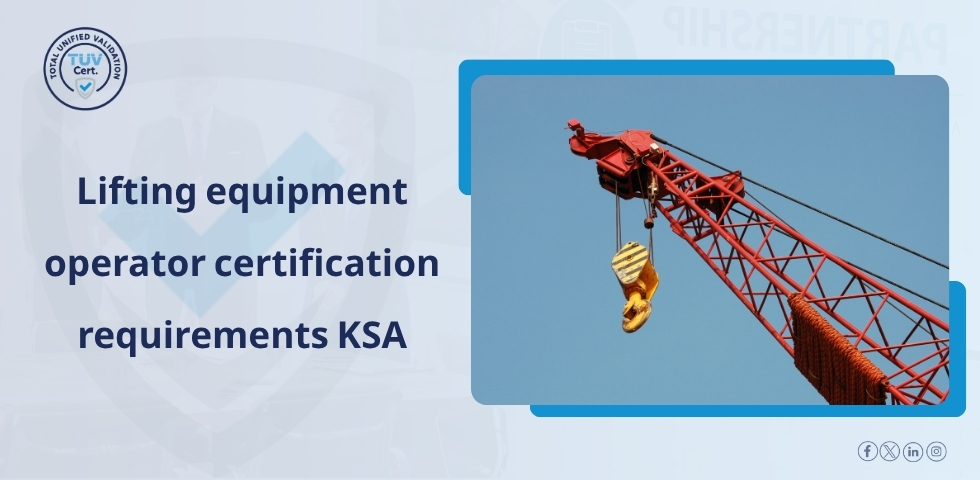
Lifting equipment operator certification requirements KSA
Obtaining a lifting equipment operator certification in Saudi Arabia requires meeting specific training and competency requirements designed to promote workplace safety and regulatory compliance.
Understanding these requirements helps individuals and organizations choose suitable training programs, develop practical operating skills, and ensure operators are prepared to work safely with lifting equipment across various industrial sectors.
What Are the Lifting Equipment Operator Certification Requirements in KSA?
Meeting the lifting equipment operator certification requirements KSA is essential for anyone responsible for operating cranes, forklifts, or other lifting machinery in Saudi Arabia.
Certification is intended to verify that operators possess the technical knowledge, practical skills, and safety awareness needed to perform lifting operations efficiently while complying with workplace regulations and recognized industry standards.
Although the exact lifting equipment operator certification requirements KSA may vary depending on the type of equipment and the employer's operational needs, most certification programs require candidates to demonstrate competency in several key areas, including:
- Safe operation of lifting equipment.
- Understanding load charts and lifting capacities.
- Conducting pre-use equipment inspections.
- Hazard identification and risk assessment.
- Applying safe lifting techniques.
- Understanding hand signals and communication procedures.
- Following emergency response protocols.
- Complying with workplace health and safety regulations.
Before joining a certification program, candidates are often expected to meet certain eligibility criteria.
These requirements help ensure participants are physically capable of operating heavy equipment and can successfully complete both theoretical and practical assessments.
While specific requirements may differ between training providers, applicants are commonly asked to provide:
- A valid identification document.
- Proof of employment or employer nomination (where applicable).
- Basic reading and communication skills.
- Medical fitness, if required by the employer or project.
- Previous operating experience for advanced certification programs.
Certification is not based solely on classroom attendance. A professional training program evaluates whether operators can apply what they have learned in real working environments.
Practical assessments are designed to measure the candidate's ability to operate equipment safely, inspect machinery before use, handle loads correctly, and react appropriately to changing site conditions.
This competency-based approach ensures that certified operators are prepared for the responsibilities they will face on the job.
Another important part of the lifting equipment operator certification requirements KSA is understanding safety legislation and operational responsibilities.
Operators must know how to comply with company procedures, follow approved lifting plans, communicate effectively with riggers and signalers, and recognize situations that require lifting operations to stop.
Building this level of awareness helps reduce workplace incidents while improving operational efficiency.
At TUV, certification programs are designed to develop both technical competence and practical confidence.
Rather than focusing only on passing an examination, TUV delivers structured training that combines theoretical instruction, supervised practical exercises, and competency-based assessments.
This approach helps participants gain the skills required to perform lifting operations safely while supporting compliance with recognized industry standards.
The certification process generally concludes with comprehensive evaluations that verify an operator's readiness for the workplace. These assessments may include:
- Written examinations covering lifting safety principles.
- Practical equipment operation tests.
- Equipment inspection demonstrations.
- Safe load handling exercises.
- Risk assessment scenarios.
- Final competency verification conducted by qualified assessors.
Organizations also benefit from ensuring their operators meet the lifting equipment operator certification requirements KSA.
Certified personnel contribute to safer workplaces, reduce the likelihood of equipment misuse, improve operational productivity, and support compliance with client expectations and regulatory requirements.
Investing in qualified operators is often far more cost-effective than dealing with accidents, downtime, or non-compliance.
By choosing TUV as a trusted training and certification provider, businesses and individual operators gain access to professionally developed programs that emphasize safety, competence, and continuous improvement.
Through internationally aligned training methodologies and practical assessments, TUV helps operators achieve certification with the knowledge and confidence required to perform lifting operations safely and efficiently.
Who Needs Lifting Equipment Operator Certification?
Obtaining lifting equipment operator certification KSA is essential for anyone responsible for operating lifting machinery in environments where safety, precision, and regulatory compliance are critical.
Certification demonstrates that an operator has the knowledge and practical competence required to carry out lifting operations safely while reducing the risk of accidents, equipment damage, and operational delays.
The need for lifting equipment operator certification KSA extends across a wide range of industries where lifting equipment is used on a daily basis.
Certified operators help organizations maintain safer workplaces and meet industry expectations in sectors such as:
- Construction and infrastructure projects.
- Oil and gas facilities.
- Manufacturing and industrial plants.
- Warehousing and logistics centers.
- Ports and shipping terminals.
- Mining operations.
- Energy and utility projects.
- Heavy engineering and fabrication facilities.
Certification is not limited to experienced professionals. Individuals entering the lifting industry also benefit from completing a recognized certification program before operating equipment independently.
Proper training equips new operators with the technical knowledge, operational skills, and safety mindset needed to perform lifting tasks confidently from the beginning of their careers.
Several job roles commonly require lifting equipment operator certification KSA, including:
- Mobile crane operators.
- Tower crane operators.
- Overhead crane operators.
- Forklift operators.
- Telehandler operators.
- Truck-mounted crane operators.
- Heavy lifting equipment operators.
- Multi-equipment operators working across different job sites.
For employers, ensuring that operators hold valid certification is equally important. Certified personnel are more likely to follow safe operating procedures, perform accurate equipment inspections, and understand load limitations before every lifting operation.
This contributes to fewer workplace incidents, improved productivity, and stronger compliance with company safety policies and industry regulations.
Another group that benefits from lifting equipment operator certification KSA is organizations working on large-scale or high-risk projects.
Many contractors and project owners require certified operators as part of their workforce qualification process before personnel are allowed to access construction sites, industrial plants, or major infrastructure projects.
Certification provides documented evidence that operators have successfully demonstrated their competency through both theoretical and practical assessments.
At TUV, certification programs are designed to support individuals at every stage of their careers, from new operators seeking their first qualification to experienced professionals renewing or expanding their competencies.
Through structured training, practical exercises, and competency-based evaluations, TUV helps participants build the confidence and technical expertise required to perform lifting operations safely and efficiently.
Certification is also valuable for companies investing in workforce development. By ensuring employees meet the lifting equipment operator certification KSA requirements, organizations can strengthen their safety culture while improving operational performance. Key business benefits include:
- Reducing workplace accidents and operational risks.
- Improving operator confidence and decision-making.
- Supporting compliance with safety regulations.
- Increasing equipment reliability through correct operation.
- Demonstrating workforce competence to clients and project stakeholders.
- Enhancing overall productivity and operational efficiency.
Ultimately, lifting equipment operator certification KSA is not simply a qualification for operating machinery—it is a professional standard that supports safe lifting practices across multiple industries.
By partnering with TUV, individuals and organizations gain access to internationally aligned certification programs that focus on practical competence, regulatory compliance, and long-term workplace safety.
Eligibility Requirements Before Enrolling
Before enrolling in a lifting equipment operator certification KSA program, candidates should ensure they meet the basic eligibility requirements established by the training provider. These requirements are designed to create a strong foundation for learning and to ensure participants can safely complete both the theoretical and practical elements of the certification process. While specific criteria may vary depending on the course and equipment type, most professional training programs follow similar standards.
To begin a lifting equipment operator certification KSA course, applicants are commonly expected to meet the following requirements:
- Be of the minimum working age required by company or local regulations.
- Provide a valid national ID or passport for registration.
- Possess basic reading and communication skills to understand training materials and safety instructions.
- Be physically capable of operating lifting equipment safely.
- Comply with any employer-specific or project-specific entry requirements, where applicable.
Educational qualifications are not always the deciding factor for enrollment. Instead, training providers place greater emphasis on an applicant's ability to understand safety procedures, follow operational instructions, and demonstrate responsible decision-making during lifting activities. This allows individuals from different technical backgrounds to qualify for training, provided they can successfully complete the course requirements.
For some advanced programs, previous operating experience may be recommended or required. This is particularly common when the certification covers specialized lifting equipment or higher-risk operations. Depending on the course, participants may be asked to demonstrate familiarity with lifting equipment before progressing to advanced practical assessments.
Examples of situations where prior experience may be beneficial include:
- Upgrading from a basic operator qualification.
- Training on specialized crane types.
- Renewing an existing operator certification.
- Completing competency reassessments for experienced operators.
- Participating in employer-sponsored advanced training programs.
Health and fitness also play an important role in lifting equipment operator certification KSA. Operators are expected to remain alert, maintain good coordination, and respond quickly to changing workplace conditions. For this reason, some employers or project owners may request a medical fitness assessment before employees participate in training or begin operating lifting equipment on active worksites.
At TUV, the enrollment process is designed to be straightforward while ensuring every participant is placed in the most appropriate certification program. The training team reviews each candidate's background, operational experience, and certification objectives to recommend a course that matches both individual capabilities and workplace requirements. This personalized approach helps participants gain the maximum benefit from their training.
Before starting the program, candidates should also prepare any documentation requested during registration. Depending on the certification pathway, this may include:
- Valid identification documents.
- Employer authorization or nomination letter (if required).
- Previous training certificates or operator licenses.
- Medical fitness documentation, when applicable.
- Employment or work experience records for advanced certification programs.
Meeting the eligibility requirements before enrolling in lifting equipment operator certification KSA helps participants begin their training with confidence and ensures they are fully prepared for both classroom instruction and practical assessments.
By choosing TUV, individuals and organizations benefit from a structured enrollment process, expert guidance, and internationally aligned certification programs that prioritize competence, safety, and long-term professional development.
What Does the Certification Assessment Include?
A key part of the lifting equipment operator certification KSA process is the certification assessment, which verifies that candidates can apply their knowledge and skills in real workplace situations. The assessment is not designed to measure theoretical knowledge alone—it evaluates whether an operator can perform lifting operations safely, follow approved procedures, and make sound decisions under normal working conditions.
A comprehensive lifting equipment operator certification KSA assessment typically covers several core areas, including:
- Knowledge of lifting safety regulations and industry standards.
- Safe operating procedures for lifting equipment.
- Understanding load charts and equipment limitations.
- Hazard identification and risk assessment.
- Daily pre-operation equipment inspections.
- Communication with riggers, signalers, and lifting teams.
- Emergency response and incident prevention.
The theoretical assessment usually comes first, allowing candidates to demonstrate their understanding of essential safety principles and operational requirements. Questions often focus on equipment functions, safe lifting practices, inspection procedures, and the responsibilities of a certified operator. Successfully completing this stage confirms that participants understand the knowledge required before operating lifting equipment in the field.
Practical evaluation is equally important because safe equipment operation can only be demonstrated through hands-on performance. During the practical assessment, candidates are observed while carrying out real operating tasks to ensure they can apply safe working practices consistently and confidently.
The practical assessment may include activities such as:
- Conducting a complete pre-use equipment inspection.
- Performing safe start-up and shutdown procedures.
- Operating lifting equipment under different working conditions.
- Lifting, moving, and positioning loads accurately.
- Following approved hand signals and communication methods.
- Maintaining equipment stability throughout lifting operations.
- Responding correctly to simulated workplace hazards.
Rather than assessing speed, professional certification programs focus on competence, precision, and safety. Assessors evaluate whether operators follow established procedures, maintain control of the equipment, and demonstrate good judgment throughout every stage of the lifting operation. This competency-based approach helps ensure certified operators are prepared for real industrial environments.
At TUV, the assessment process is designed to reflect actual workplace expectations. Candidates complete structured theoretical and practical evaluations under the supervision of qualified assessors with extensive industry experience. By combining technical knowledge with hands-on performance testing, TUV ensures that certification represents genuine operational competence rather than attendance alone.
Assessment criteria are developed to verify a broad range of professional skills, including:
- Equipment control and operational accuracy.
- Compliance with lifting procedures.
- Situational awareness during lifting activities.
- Proper use of personal protective equipment (PPE).
- Ability to identify unsafe conditions before work begins.
- Effective communication throughout the lifting operation.
- Safe decision-making under realistic operating scenarios.
Successfully completing the lifting equipment operator certification KSA assessment demonstrates that an operator has met recognized competency standards and is capable of performing lifting operations responsibly. For employers, this provides confidence that certified personnel have been evaluated through a structured process rather than simply completing a training course.
By choosing TUV, individuals and organizations benefit from a certification assessment that emphasizes practical capability, regulatory compliance, and workplace safety. This rigorous evaluation process helps develop skilled operators who are ready to contribute to safer, more efficient lifting operations across construction, manufacturing, logistics, and other industrial sectors.
How TUV Supports Lifting Equipment Operator Certification
Achieving lifting equipment operator certification KSA requires more than completing a training course—it requires a structured process that develops technical knowledge, practical competence, and a strong commitment to workplace safety. TUV supports individuals and organizations throughout every stage of the certification journey by delivering professional training and competency-based assessments that align with recognized industry standards.
Rather than offering a one-size-fits-all approach, TUV tailors its certification programs to match the operational needs of different industries and equipment types. Whether participants operate mobile cranes, overhead cranes, forklifts, or other lifting equipment, the training focuses on building the practical skills and confidence required for safe daily operations.
As part of its lifting equipment operator certification KSA programs, TUV provides:
- Comprehensive theoretical training.
- Hands-on practical instruction.
- Competency-based operator assessments.
- Guidance from experienced industry professionals.
- Training aligned with international best practices.
- Certification for successful candidates after completing all required evaluations.
One of the key strengths of TUV is its emphasis on practical learning. Operators are not expected to rely solely on classroom instruction. Instead, they participate in realistic training exercises that simulate workplace conditions, allowing them to apply safe operating techniques, equipment inspection procedures, and load-handling practices before working in real industrial environments.
The certification process at TUV is designed to evaluate both knowledge and performance. Every participant is assessed through structured examinations and practical demonstrations to verify that they can safely operate lifting equipment while following approved operational procedures. This competency-focused approach ensures that certification reflects real capability rather than simple course attendance.
During the lifting equipment operator certification KSA process, TUV helps participants develop essential professional skills such as:
- Performing pre-operation equipment inspections.
- Interpreting load charts and operating limits.
- Identifying workplace hazards before lifting begins.
- Applying safe lifting and maneuvering techniques.
- Communicating effectively with riggers and signalers.
- Responding appropriately to emergency situations.
- Following company procedures and recognized safety standards.
For organizations, TUV offers certification solutions that support workforce development and long-term operational excellence. By ensuring employees receive consistent, high-quality training, companies can improve safety performance, strengthen regulatory compliance, and increase confidence in their lifting operations. This makes certification an important investment in both people and business performance.
Another advantage of choosing TUV for lifting equipment operator certification KSA is its commitment to continuous quality and industry relevance. Training programs are regularly reviewed to reflect evolving safety practices, operational requirements, and industry expectations. This ensures that participants receive up-to-date knowledge and practical guidance that can be applied immediately in the workplace.
Meeting the lifting equipment operator certification requirements KSA is an important step toward building a safer, more competent workforce.
Proper certification ensures that operators have the technical knowledge, practical experience, and safety awareness needed to perform lifting operations with confidence.
By choosing TUV, individuals and organizations gain access to internationally aligned training and competency-based certification programs that support regulatory compliance, improve operational performance, and promote a strong culture of workplace safety.
Frequently Asked Questions About Lifting Equipment Operator Certification Requirements in KSA
1. What are the lifting equipment operator certification requirements KSA?
The lifting equipment operator certification requirements KSA generally include completing an approved training program, successfully passing both theoretical and practical assessments, and demonstrating the competence required to operate lifting equipment safely. Specific requirements may vary depending on the equipment type and employer.
2. Who should obtain lifting equipment operator certification in Saudi Arabia?
Anyone responsible for operating lifting equipment—such as mobile cranes, overhead cranes, forklifts, tower cranes, or telehandlers—should obtain certification to demonstrate their competency and support safe workplace operations.
3. Is previous experience required before enrolling in a certification course?
Not always. Many entry-level certification programs accept beginners, while advanced courses for specialized equipment may require prior operating experience or an existing operator qualification.
4. What documents are typically required for enrollment?
Most training providers request:
- A valid ID or passport.
- Employer authorization, if applicable.
- Previous certificates for advanced courses.
- Medical fitness documentation when required.
- Any additional documents specified by the training provider.
5. What does the certification assessment include?
The assessment usually consists of both theoretical and practical evaluations, including safety regulations, equipment operation, pre-use inspections, hazard identification, load handling, and competency demonstrations under the supervision of qualified assessors.