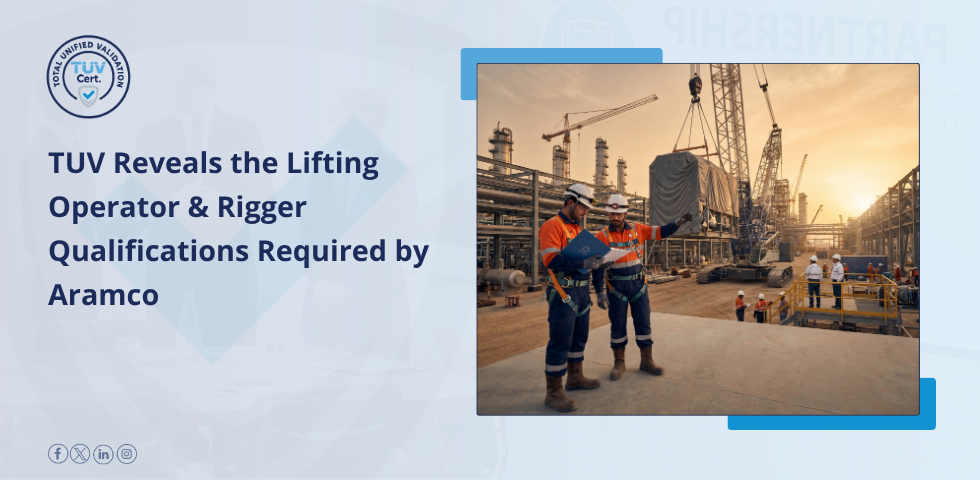
crane operator certification Saudi Arabia The Key to Unlocking Better Career Opportunities
Want Faster Site Approval? TUV Explains the Qualifications Aramco Looks for First
Have you ever wondered why some operators receive site approval within days while others face repeated delays, document rejections, or restricted access despite having years of experience in the field?
The answer often has little to do with experience alone and everything to do with qualifications.
In today's highly regulated industrial environment, major projects are no longer looking for workers who simply know how to operate equipment.
They are looking for professionals who can prove their competence through recognized certifications such as crane operator certification Saudi Arabia, validated assessments, and documented compliance with project requirements.
For companies working on large-scale energy, construction, and oil & gas projects, possessing the right credentials can mean the difference between immediate approval and costly waiting periods.
What many professionals fail to realize is that Aramco and other leading project owners prioritize qualification before experience.
A candidate holding a recognized lifting operator qualification Aramco often has a significant advantage because their skills have already been assessed against accepted industry standards.
Similarly, a verified heavy equipment operator certificate Riyadh demonstrates that the operator has undergone structured training and competency evaluation rather than relying solely on field exposure.
The same principle applies to lifting and rigging personnel. A recognized rigging certification Saudi Arabia is no longer viewed as an optional career enhancement.
It has become a critical requirement for individuals involved in lifting operations, load handling, signaling, and heavy equipment activities across many industrial sites.
Employers want confidence that every person participating in high-risk operations understands safety procedures, operational limits, hazard controls, and industry best practices.
Aramco GI-8 Requirements: Which Operators & Riggers Need Certification Before Site Access?
Why do some workers gain immediate access to major industrial projects while others face delays, additional assessments, or even rejection before entering the site? The answer often lies in one critical factor: certification compliance.
Across Saudi Arabia's industrial sector, particularly within oil & gas, petrochemical, energy, and infrastructure projects, safety and competency verification have become non-negotiable requirements.
Aramco's GI-8 requirements are designed to ensure that personnel involved in lifting operations possess the necessary skills, knowledge, and practical competence to perform their duties safely and efficiently.
These requirements are not merely administrative procedures; they are part of a broader commitment to reducing incidents, protecting personnel, and maintaining operational excellence.
For operators and riggers, qualifications such as crane operator certification Saudi Arabia, an approved lifting operator qualification Aramco, a recognized heavy equipment operator certificate Riyadh, and a valid rigging certification Saudi Arabia often play a decisive role in determining whether an individual is eligible for site access.
Employers, contractors, and project owners increasingly seek personnel who can demonstrate verified competency rather than relying solely on years of experience.
Understanding who requires certification, why certification matters, and how the qualification process works can help companies avoid costly project delays while helping workers advance their careers within Saudi Arabia's growing industrial sector.
Understanding the Purpose of Aramco GI-8
Aramco GI-8 focuses on lifting operations and personnel competency.
The primary objectives include:
- Reducing lifting-related incidents.
- Improving operational safety.
- Standardizing competency requirements.
- Verifying operator qualifications.
- Ensuring proper rigging practices.
These requirements apply to personnel directly involved in lifting activities where mistakes can result in severe injuries, equipment damage, environmental impact, or costly project disruptions.
Because of this, qualifications such as crane operator certification Saudi Arabia and rigging certification Saudi Arabia are frequently considered essential components of workforce compliance.
Which Crane Operators Require Certification?
Crane operators are among the most heavily regulated personnel within lifting operations.
Typically, certification requirements apply to operators of:
- Mobile cranes.
- Crawler cranes.
- Rough terrain cranes.
- Truck-mounted cranes.
- Tower cranes.
- Specialized lifting cranes.
Possessing a recognized crane operator certification Saudi Arabia demonstrates that the operator has successfully completed both theoretical and practical competency assessments.
A valid lifting operator qualification Aramco further confirms that the operator meets project-specific competency expectations.
Without appropriate certification, operators may experience delays in approval or restrictions regarding site access.
Which Riggers Need Certification?
Many workers underestimate the importance of rigging personnel.
However, riggers play a critical role in every lifting operation.
Certification commonly applies to:
- General riggers.
- Advanced riggers.
- Lead riggers.
- Rigging supervisors.
- Load-handling personnel.
- Personnel involved in lifting preparation.
A recognized rigging certification Saudi Arabia demonstrates competency in:
- Sling selection.
- Load calculations.
- Rigging inspections.
- Hazard identification.
- Safe lifting procedures.
- Communication protocols.
Because riggers directly influence load stability and lifting safety, certification is often considered mandatory before participation in lifting activities.
The Importance of Signalers and Slinger Personnel
Lifting operations depend heavily on effective communication.
Signalers and slinger personnel frequently require competency verification because they:
- Direct crane movements.
- Coordinate lifting activities.
- Communicate hazards.
- Assist with load positioning.
- Prevent unsafe operations.
Although their responsibilities differ from crane operators, their role significantly impacts lifting safety.
Many organizations therefore require training and competency assessment alongside rigging certification Saudi Arabia programs.
Heavy Equipment Operators and GI-8 Compliance
Not all lifting-related activities involve cranes.
Many projects also involve heavy equipment operators whose work may impact lifting operations.
Examples include:
- Forklift operators.
- Telehandler operators.
- Reach stacker operators.
- Specialized equipment operators.
- Material handling operators.
A recognized heavy equipment operator certificate Riyadh demonstrates that operators possess the necessary technical skills and safety awareness required for industrial projects.
When combined with a valid lifting operator qualification Aramco, these credentials significantly improve eligibility for site approval.
Why Experience Alone Is No Longer Enough
For many years, workers relied primarily on field experience.
Today, however, project owners demand documented evidence of competence.
Several reasons explain this shift:
- Increasing project complexity.
- Higher safety expectations.
- Regulatory requirements.
- International best practices.
- Contractor accountability.
An individual may have ten years of experience, but without recognized qualifications such as crane operator certification Saudi Arabia or rigging certification Saudi Arabia, proving competency becomes significantly more difficult.
Certification provides objective evidence that knowledge and practical skills have been independently verified.
The Typical Qualification Process
Most competency programs involve multiple stages.
These commonly include:
- Application review.
- Identity verification.
- Document assessment.
- Written examination.
- Practical assessment.
- Performance evaluation.
The written assessment evaluates technical knowledge, while the practical assessment confirms operational competence.
Candidates seeking crane operator certification Saudi Arabia or lifting operator qualification Aramco should be prepared to demonstrate both theoretical understanding and real-world operational ability.
Common Areas Evaluated During Assessments
Certification programs often focus on critical operational competencies.
These include:
- Equipment inspection procedures.
- Load chart interpretation.
- Risk assessment.
- Lift planning.
- Emergency response procedures.
- Communication techniques.
- Safe operating practices.
For candidates pursuing rigging certification Saudi Arabia, additional emphasis may be placed on:
- Sling selection.
- Load securing.
- Center of gravity identification.
- Rigging hardware inspection.
These competencies directly influence lifting safety and operational reliability.
How Certification Benefits Employers
Certification is not only valuable for workers.
Employers also gain significant advantages.
These benefits include:
- Faster workforce approval.
- Improved safety performance.
- Reduced incident rates.
- Increased client confidence.
- Enhanced regulatory compliance.
When personnel possess valid crane operator certification Saudi Arabia, heavy equipment operator certificate Riyadh, and rigging certification Saudi Arabia, companies can often streamline workforce mobilization and reduce administrative delays.
How Certification Benefits Workers
For individual workers, certification creates opportunities for career advancement.
Certified personnel often experience:
- Greater employability.
- Increased earning potential.
- Access to major projects.
- Improved professional credibility.
- Stronger long-term career prospects.
Holding a recognized lifting operator qualification Aramco can significantly strengthen a worker's profile when applying for industrial positions throughout Saudi Arabia.
Likewise, maintaining current crane operator certification Saudi Arabia and rigging certification Saudi Arabia credentials demonstrates ongoing commitment to professional development and workplace safety.
Avoiding Common Qualification Mistakes
Many applicants encounter delays because of preventable mistakes.
Common issues include:
- Expired certificates.
- Incomplete documentation.
- Unverified training records.
- Insufficient practical experience.
- Failure to prepare for assessments.
Organizations and workers should review qualification requirements carefully before submitting applications.
Proper preparation often accelerates approval and minimizes unnecessary project delays.
Aramco GI-8 requirements reflect the growing importance of competency verification across Saudi Arabia's industrial sector.
Whether the role involves operating cranes, managing heavy equipment, directing lifting operations, or performing rigging activities, certification has become a critical requirement rather than an optional advantage.
Qualifications such as crane operator certification Saudi Arabia, a recognized lifting operator qualification Aramco, a valid heavy equipment operator certificate Riyadh, and an approved rigging certification Saudi Arabia provide documented evidence that personnel possess the knowledge and practical skills required to perform safely in high-risk environments.
As industrial projects continue to expand across the Kingdom, certified professionals will remain in high demand.
Understanding the qualification requirements today can help both employers and workers achieve faster approvals, stronger compliance, and greater opportunities within the region's most important industrial projects.
Stage 1 vs Stage 2: How Aramco Assesses Operator & Rigger Competency?
Why do some operators and riggers pass competency assessments on their first attempt while others struggle despite having years of field experience?
The answer often lies in understanding how the assessment process actually works.
Many professionals mistakenly assume that operational experience alone guarantees success.
However, Aramco's competency assessment approach is designed to evaluate much more than time spent on a job site.
It focuses on verified knowledge, practical capability, safety awareness, decision-making skills, and the ability to perform consistently under real operating conditions.
This is why qualifications such as crane operator certification Saudi Arabia, a recognized lifting operator qualification Aramco, a valid heavy equipment operator certificate Riyadh, and an approved rigging certification Saudi Arabia have become increasingly important across Saudi Arabia's industrial sector.
These credentials demonstrate that operators and riggers possess both the theoretical understanding and practical competency required to work safely on high-risk projects.
The assessment process is generally divided into two critical stages. Stage 1 evaluates what candidates know, while Stage 2 evaluates what they can actually do.
Understanding the difference between these two stages can significantly improve preparation, increase success rates, and accelerate approval for major industrial projects.
Why Aramco Uses a Two-Stage Assessment System
The primary objective of competency assessment is verification.
Project owners need confidence that personnel can:
- Work safely.
- Follow procedures.
- Operate equipment correctly.
- Identify hazards.
- Respond appropriately to unexpected situations.
A written test alone cannot confirm practical competence.
Likewise, practical performance alone cannot guarantee sufficient technical knowledge.
This is why qualifications such as crane operator certification Saudi Arabia and rigging certification Saudi Arabia typically include both theoretical and practical assessment components.
The two-stage approach provides a more complete picture of candidate competency.
Understanding Stage 1: The Written Assessment
Stage 1 focuses primarily on technical knowledge.
This assessment evaluates whether candidates understand the principles behind safe operations before they are permitted to demonstrate practical skills.
The written examination commonly includes questions related to:
- Safety regulations.
- Equipment limitations.
- Load charts.
- Risk assessments.
- Inspection procedures.
- Emergency response actions.
- Industry terminology.
Candidates pursuing lifting operator qualification Aramco are expected to demonstrate a clear understanding of operational standards and safety requirements.
This stage helps identify individuals who may have experience but lack the technical foundation necessary for safe decision-making.
What Crane Operators Are Evaluated On During Stage 1
Candidates seeking crane operator certification Saudi Arabia are often assessed on several critical knowledge areas.
These include:
- Crane stability principles.
- Rated capacity calculations.
- Load chart interpretation.
- Ground condition assessment.
- Weather-related lifting limitations.
- Pre-operation inspections.
- Hazard identification.
The goal is to verify that operators understand not only how equipment functions but also why specific procedures exist.
This knowledge becomes essential when making operational decisions in the field.
What Riggers Are Evaluated On During Stage 1
For candidates pursuing rigging certification Saudi Arabia, the written assessment focuses heavily on lifting preparation and load control.
Topics often include:
- Sling angles.
- Working load limits.
- Rigging hardware.
- Center of gravity calculations.
- Load securing techniques.
- Communication procedures.
- Lift planning fundamentals.
Strong theoretical knowledge provides the foundation necessary for safe rigging operations.
Without this knowledge, practical experience alone may not be sufficient.
Why Some Candidates Fail Stage 1
One of the most common misconceptions is that years of experience automatically guarantee success.
However, many candidates struggle because they:
- Rely entirely on field habits.
- Ignore technical standards.
- Have outdated knowledge.
- Lack familiarity with written assessments.
- Fail to prepare adequately.
Candidates pursuing heavy equipment operator certificate Riyadh, crane operator certification Saudi Arabia, or rigging certification Saudi Arabia should prepare carefully for the theoretical portion rather than assuming experience will carry them through.
Understanding Stage 2: The Practical Assessment
Stage 2 focuses on performance.
This stage evaluates whether candidates can apply their knowledge correctly in realistic operating environments.
Unlike Stage 1, candidates are observed performing actual tasks.
Assessors evaluate:
- Equipment handling.
- Operational accuracy.
- Safety awareness.
- Communication skills.
- Hazard recognition.
- Compliance with procedures.
The practical assessment is often considered the most important component of lifting operator qualification Aramco programs because it reflects real workplace performance.
Practical Assessment for Crane Operators
Candidates completing crane operator certification Saudi Arabia are typically required to demonstrate safe operation under controlled conditions.
Practical tasks may include:
- Conducting pre-use inspections.
- Positioning equipment correctly.
- Reading operational indicators.
- Performing lifting maneuvers.
- Following safety protocols.
- Maintaining load control.
Assessors closely observe every action.
Even experienced operators can lose points if they skip procedures or demonstrate unsafe practices.
Practical Assessment for Riggers
For candidates pursuing rigging certification Saudi Arabia, practical evaluations often focus on lifting preparation and load management.
Candidates may be required to:
- Inspect rigging equipment.
- Select appropriate slings.
- Assemble lifting arrangements.
- Identify unsafe conditions.
- Calculate sling configurations.
- Direct lifting activities.
Practical competency is essential because rigging errors can significantly increase operational risk.
Heavy Equipment Assessment Requirements
Candidates seeking a heavy equipment operator certificate Riyadh must also demonstrate operational competence.
Assessment areas frequently include:
- Equipment inspections.
- Safe startup procedures.
- Operational controls.
- Site awareness.
- Equipment positioning.
- Shutdown procedures.
The emphasis is placed on safe and consistent performance rather than speed alone.
Common Mistakes During Stage 2
Many candidates fail practical assessments because they focus exclusively on equipment operation.
However, assessors evaluate much more than technical ability.
Common errors include:
- Poor hazard awareness.
- Skipping inspections.
- Failure to follow procedures.
- Inadequate communication.
- Unsafe positioning.
- Lack of situational awareness.
These mistakes can significantly affect results regardless of experience level.
How Assessors Measure Competency
Assessors use structured evaluation criteria designed to eliminate subjectivity.
Typical assessment categories include:
- Technical knowledge application.
- Safety compliance.
- Equipment control.
- Communication effectiveness.
- Risk management.
- Procedural adherence.
Candidates pursuing lifting operator qualification Aramco are expected to demonstrate competency across all categories rather than excelling in only one area.
Why Both Stages Matter Equally
Some candidates view Stage 1 as the difficult part and Stage 2 as a formality.
Others believe the opposite.
In reality, both stages serve different purposes.
Stage 1 verifies knowledge.
Stage 2 verifies performance.
A candidate who passes only one stage cannot demonstrate complete competency.
This is why certification pathways such as crane operator certification Saudi Arabia, heavy equipment operator certificate Riyadh, and rigging certification Saudi Arabia typically require successful completion of both phases.
How Candidates Can Improve Their Success Rate
Preparation is the most effective strategy.
Candidates should focus on:
- Reviewing technical standards.
- Understanding safety requirements.
- Practicing equipment inspections.
- Refreshing load calculation skills.
- Following operational procedures consistently.
- Participating in competency-focused training.
Structured preparation often makes the difference between passing and failing.
The Role of Certification Providers
Professional certification providers play a critical role in preparing candidates for assessment success.
Quality training programs help participants:
- Understand assessment expectations.
- Improve technical knowledge.
- Strengthen practical skills.
- Identify weaknesses.
- Build confidence before testing.
This preparation is particularly valuable for individuals seeking crane operator certification Saudi Arabia, lifting operator qualification Aramco, heavy equipment operator certificate Riyadh, and rigging certification Saudi Arabia.
Aramco's two-stage competency assessment system is designed to ensure that operators and riggers possess both the knowledge and practical ability required for safe industrial operations.
Stage 1 verifies technical understanding through written assessment, while Stage 2 confirms that candidates can apply that knowledge effectively in real-world situations.
Together, these stages create a comprehensive evaluation process that supports safer worksites, stronger operational performance, and greater workforce reliability.
For professionals pursuing crane operator certification Saudi Arabia, obtaining a recognized lifting operator qualification Aramco, earning a respected heavy equipment operator certificate Riyadh, or completing rigging certification Saudi Arabia, understanding the purpose and expectations of each stage is essential.
Success depends not only on experience but also on preparation, competency, and the ability to consistently demonstrate safe and professioIn conclusion, meeting Aramco's qualification requirements is no longer simply about checking a box on a project compliance list—it is about proving competency, building credibility, and opening the door to some of the most valuable industrial opportunities in Saudi Arabia.
Whether you are pursuing crane operator certification Saudi Arabia, seeking a recognized lifting operator qualification Aramco, obtaining a professional heavy equipment operator certificate Riyadh, or completing a trusted rigging certification Saudi Arabia, every qualification you earn strengthens your position in an increasingly competitive industry.
The reality is simple: companies want qualified personnel, project owners want verified competency, and major industrial sites want confidence that every lifting operation will be performed safely and professionally.
The professionals who invest in the right qualifications today are often the ones who secure faster approvals, stronger career opportunities, and greater long-term success tomorrow.
That is where TUV makes the difference. We do not simply provide assessments—we help individuals and organizations understand exactly what is required to meet industry expectations and confidently move through the qualification process.
From crane operator certification Saudi Arabia programs to comprehensive rigging certification Saudi Arabia assessments, from advanced lifting operator qualification Aramco requirements to specialized heavy equipment operator certificate Riyadh pathways, our goal is to support your journey toward compliance, competence, and professional growth.
Why wait until a project opportunity is delayed because of missing qualifications? Why risk approval setbacks when the right preparation can put you ahead of the competition?
Take the next step today. Invest in your future, strengthen your credentials, and position yourself for success on major industrial projects across the Kingdom.
Contact TUV now and let our experts guide you through the process of obtaining the qualifications that matter most. Whether your goal is achieving crane operator certification Saudi Arabia, earning a recognized lifting operator qualification Aramco, securing a respected heavy equipment operator certificate Riyadh, or completing rigging certification Saudi Arabia, we are ready to help you move forward with confidence.
Your next opportunity could depend on the qualifications you earn today. Let TUV help you get there faster, smarter, and with the professional recognition that leading employers and project owners trust.
With TUV, certification is not just a document—it is your pathway to safer operations, greater credibility, stronger career prospects, and access to the projects that define the future of Saudi Arabia's industrial sector.
Reach out today and start your qualification journey with a partner committed to your success.